

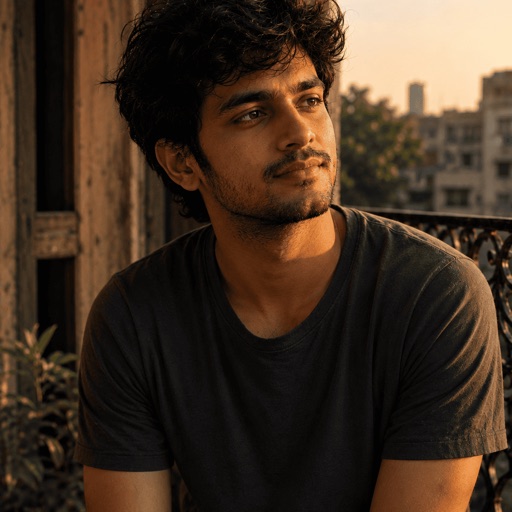
In the summers the current went at nine and the whole building climbed to the terrace to sleep. We carried up our thin cotton mattresses and the steel jug of drinking water, and the aunties spread bedsheets in a grid everyone somehow honoured — this square is ours, that one belongs to the Kulkarnis — and we children lay in the gaps between families and pretended to sleep so we could listen to the grown-ups talk in the dark about people we didn't know.
The sky over our part of Pune still held stars then. Milind, who slept to my left every night from June to the first rain, taught me the three or four constellations his father had taught him, all of them wrong, I found out much later — invented names pinned onto real stars. It did not matter. When the current came back at some black hour and the stairwell tube light stuttered on, one of the fathers would groan and go down to switch off the fans nobody was lying under, and we would stay up top anyway, because who would trade the open sky for a room.
The building has a lift now, and inverters, and every flat its own AC humming into the lane. Nobody climbs to the terrace. I went, this visit — my mother handed me the key, surprised anyone wanted it — and the water tank is bigger, and there is a mobile tower bolted to the corner where the Kulkarnis used to sleep, blinking its red light all night at nothing.
I lay down on the warm cement in the square that used to be ours. The sky over Pune has no stars left to speak of; the city keeps them out now. But I found the four Milind had given me, or four that would do, and I said his wrong names over them one more time, out loud, to a terrace that held no one but me.